「行旅 Caravan」
Solo Exhibition
Opening:2026年10月7日,星期三,13:30-18:30
Duration:2026年10月7日 至 2026年10月31日(预约制)
Address:杭州市上城区万松岭路90号, Hangzhou
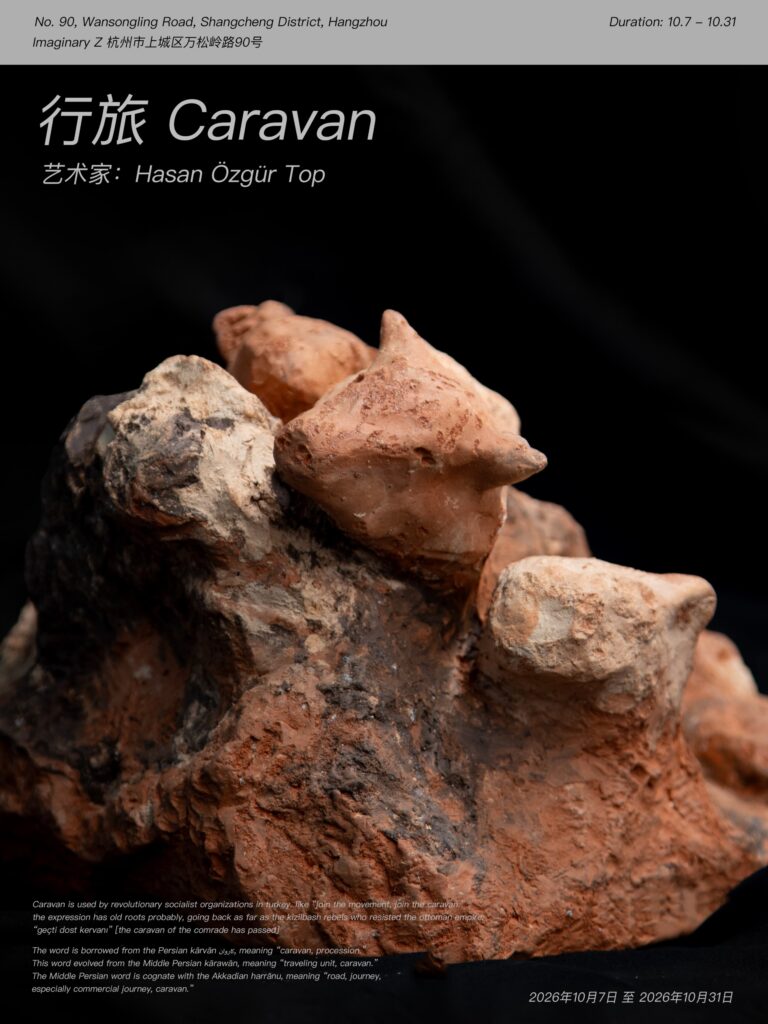
Imaginary Z is pleased to present Hasan Özgür Top’s solo exhibition, “Caravan”. The exhibition will open on October 7, 2026, and run through October 31, 2026.
NATURAL REVOLT
By Mandus Ridefelt
The centerpiece of Hasan Özgür Top’s exhibition Caravan is titled First Revolt. Its protagonist, Professor Yılmaz, has discovered paintings and ceramic objects in a cave that predate any known artistic expression. Drawing on the art historian Max Raphael, Yılmaz claims that these archaic aesthetic objects are representations of social struggle or revolt.1 While other species and life forms also might have the capacity to make art, it is a momentous claim to turn revolt into the social bedrock of aesthetic activity.
The film moves by interrogating the hypothesis at hand: the origin of art is entangled with social struggle. Experts and scientific institutes scrutinize the discovery, lending it credibility in one passage and undermining it in another. Ultimately, the authenticity of the artefacts is rejected by an authoritative German archeological institute, resulting in personal tragedy for Professor Yılmaz. Yet, an echo of the planted belief lingers within the deceptive narrative. Perhaps the failed validation of the true origin of the aesthetic traces of revolt is not a genuine resolution to the question asked? Perhaps the purported fraud is as much of an artifact itself? Who gets the last word?
In the face of being accused of fraud, Yılmaz’s almost testimonial insistence concerning the gravity of the objects points us away from the question of provenance. Perhaps it is so that, in opposition to the experts who argue that revolts should be impossible without advanced social hierarchies (found only later in history), revolts are observable through art. That art is the most sensitive organ by which we can listen to revolt, by which we can behold struggle.
To make sense of Yılmaz’s insistence about the nature of the artifacts, we need to consider revolts as natural phenomena – as something that we can observe, register and record independently of our beliefs about it. Oftentimes, scientific observations align with theoretical predictions – a natural phenomena acts like we think it should. But natural phenomena are sometimes unruly and anomalous. Stars might shine way too bright for what we know of the sky. However, the fact that we cannot explain an observation, does not undo the same observation. Things keep on existing regardless of if we know why they exist. Through Yılmaz, we encounter the aesthetic revolt // revolt aesthetic in a droning absence of scholarly context and explanation. This observation of revolt is delirious – almost an epiphany that turns Yılmaz’s art historical twist into a Warburgian resolve.2 Even though we lack reasons for why we observe a revolt, it is still possible to be sure when we witness one. Just like a natural phenomena, revolts exist empirically no matter of paleosociological context, carbon-14 dating to reconstruct their origin story, and no matter if its material squares up with institutional validation.
In 1872, the socialist revolutionary Louis Auguste Blanqui presented his cosmological thesis of the eternal return. Blanqui argues that, since the universe is composed of “one hundred simple bodies,” the history of all possible planets is contained within a finite set of “generic combinations.”3 If a “combination” is actually happening is determined by the contingency of political organization. One of the generic combinations of cosmos is the revolt. For Blanqui, just like for Yılmaz, the pattern of revolt seems to exist independently of its particular instantiations.
While the transhistorical and unitary nature of revolts is a common theme for many political thinkers, perhaps a naturalization of revolt might be an interesting proposition. How do we insist on the reality of revolt, when under the pressure to forget all that caused it? Just like natural phenomena, the patterns of social upheaval and resistance are both continuous over time and rarely in need of institutional validation. Ironically, we do not need to know the origin of revolt to own it, to enjoy it and to make it a part of one’s future. Similarly, no one believes that revolts exclusively belong in the past only because an authoritative body has declared it dead.
Thinking of revolt as a natural pattern unlocks a poetics of struggle that sometimes disappears in the labyrinth of historicism. It liberates the ontology of struggle from contingent tragedies and disappointments. It is not forgetfulness, but a world where the revolt is both existing as a form of contextually derived absolute presence, and as an ethereal law of nature (revealed through art-making). Professor Yilmaz is a prophet of the latter. And it is somewhat telling that the personal downfall of Yilmaz has nothing to do with the revolt as such. Instead, Yilmaz’s misfortune started the moment he wanted to make people believe.
- Max Raphael, Prehistoric Cave Paintings, New York, Pantheon, 1945, Bollingen Series, no. 4. ↩︎
- Warburg’s idea of the Pathos formula proposed that certain highly charged tropes and elements in images are possible to interpret independently of the context of how the image was made. Here we can think of the pattern of revolt as an example of a Pathos-formula that can be operative in the absence of any context of explanation i.e. the lack of prehistoric social hierarchies as a cause. ↩︎
- Louis Auguste Blanqui, L’éternité par les astres. Librairie Germer Bailliére, 1872, Paris marxists.org translated by Mitch Abidor; Italics from the original. ↩︎